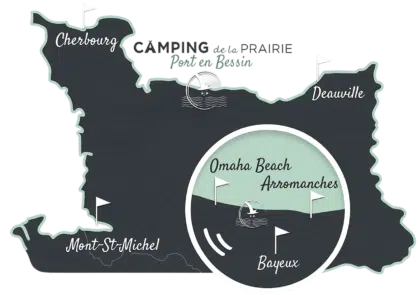

Arromanches
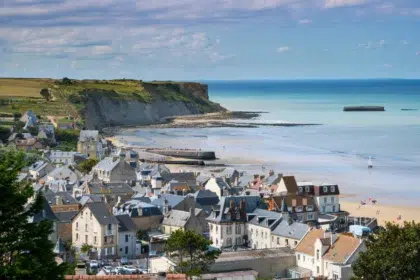
The artificial port, a real technical feat and a challenge to time…
“Since we have no ports, we’ll bring our own,” declared Churchill shortly before the D-Day landings on the beaches of Normandy in June 1944.
In the space of just eight days, Arromanches-les-Bains was transformed into a world-class artificial harbour:
- 8 kilometers of harbor
- 9,000 tonnes of equipment unloaded every day
- More than 100 Phoenix concrete boxes
- 6 kilometers of floating roads
On the beach at Arromanches, you can still admire the impressive remains of Port Winston, concrete testimony to this incredible technical feat devised to support Allied troops.
Also worth seeing are the“Arromanches 360°” circular cinema, where you can relive the incredible hours of June 6, 1944, and the D-Day Museum (photos, models, equipment, weapons, etc.).
For more information, click here.
An idea born of necessity
To understand the significance of the Arromanches artificial harbour, we need to place ourselves in the strategic context of the summer of 1944. The Allies knew that the success of the D-Day landings would depend not only on capturing the beaches, but also on feeding, arming and fuelling the hundreds of thousands of men engaged in the battle. However, the major ports of Normandy – Cherbourg, Le Havre and Brest – were solidly held by the Germans, who were determined to defend or destroy them before abandoning them. To storm a fortified port would have cost precious time and considerable loss of life.
The ingenious idea of the Allied planners was to get around the problem: since it was impossible to seize an existing port quickly, one would be built from scratch, on the open sea, in record time. Two artificial ports, named Mulberry A and Mulberry B, were designed in secret in Great Britain over many months, before being towed to the Normandy coast in the days following June 6. Mulberry B, at Arromanches, was quickly christened Port Winston, in tribute to the British Prime Minister whose vision had made the project possible.
A metamorphosis in eight days
What happened at Arromanches between June 6 and 14, 1944 was an absolute feat. In the space of just eight days, a small coastal town in Normandy was transformed into one of the world’s largest ports. The figures are staggering: over 100 Phoenix concrete caissons, each weighing several thousand tonnes, were poured to form the artificial breakwater protecting the harbour from the storms of the English Channel. These concrete behemoths, as tall as multi-storey buildings, were towed from England and positioned with remarkable precision to create an 8-kilometre-long harbour, sheltered from waves and wind.
Within this protected harbor, 6 kilometers of floating roads were deployed, enabling military vehicles to drive directly to the supply ships without ever touching the bottom. Every day, some 9,000 tons of supplies – food, ammunition, fuel, medical equipment and vehicles – were unloaded and transported to the front. In less than a hundred days of operation, Port Winston enabled the landing of more than 2.5 million soldiers, 500,000 vehicles and 4 million tonnes of supplies. These figures give an idea of the decisive strategic importance of this extraordinary facility.
A violent storm hit the Normandy coast on June 19 and 20, 1944, partially destroying the American Mulberry A port at Saint-Laurent-sur-Mer. The port of Arromanches, better protected by the natural configuration of the bay, withstood the storm and continued to operate until November 1944, well beyond the ninety days initially planned.
The remains of Port Winston, witnesses to eternity
Almost eighty years after the fact, the remains of Port Winston are still visible from the beach at Arromanches, and it’s one of the most striking experiences the Normandy coast has to offer. At low tide, the Phoenix caissons emerge from the waves like ancient ruins, grey and silent, resisting for decades the repeated assaults of the sea. These eroded but standing masses of concrete are the living symbol of a human will that refused to be defeated by obstacles. To stand on the beach and contemplate them is to touch history at its most concrete and tangible.
Re-live June 6: Arromanches 360° and the D-Day Museum
To extend and deepen the experience, Arromanches offers two must-see tours. The Arromanches 360° circular cinema offers a unique, immersive projection experience: on an enveloping 360-degree screen, the film The Price of Freedom combines original archive footage shot in June 1944 with contemporary shots of the same locations, creating a moving dialogue between past and present. A rare format that literally plunges viewers into the heart of the events.
Just a stone’s throw from the beach, the Musée du Débarquement d’Arromanches tells the complete story of Operation Overlord and the artificial port, through a rich collection of period photographs, detailed models recreating the port at its height, authenticmilitary equipment andweapons used during the fighting. An educational and moving visit, ideal for the whole family, which provides a detailed understanding of how this technical feat was conceived, built and operated under often extreme conditions.
Arromanches is all of these things: a quiet Norman village, a sandy beach facing the immensity of the English Channel, and standing in the waves, the concrete ghosts of a port that changed the course of history.